Loading... Please wait..."Why pay marine prices when the automotive product looks pretty much the same?" Good question; and one we hope you will never have to answer the hard way!
Most boaters have encountered the failure of equipment due to corrosion or poor connections. Most boat fires are directly related to a faulty electrical system. A non-operative bilge pump, due to wire corrosion or terminal failure, can cause a boat to sink. Wiring used aboard boats is subjected to four operating conditions not generally encountered ashore - vibration, the ever present salt-laden moisture in the atmosphere, contamination by various chemicals-particularly oil, diesel, dirty bilge water, and exposure to ultraviolet rays from sunlight.
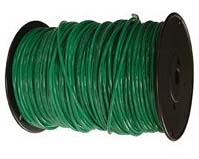
Electrical Wire When installing solar panels and wind generators, high quality marine grade electrical wire must be used to get peak power from those devices. Each strand of wire offered by e-Marine has a tin coating for corrosion resistance (note the silver look to each strand). Ordinary automotive wire can suffer a loss of conductivity due to corrosion after only a few months in a marine environment. Corrosion takes place when water enters the wire jacket and insulation.
How to Determine the Wire Gauge To Use
Common practice is to allow up to 3% voltage drop across a DC circuit.
Length (feet): Determined by measuring the length of the conductor from the positive (+) power source connection to the electrical device and back to the negative (-) power source connection.
Current ( amps ): Determined by adding the total amps on a circuit.
Formula: Use the following formula and Table A to determine the proper wire size (National Fire Protection Agency and Coast Guard require that the next larger wire size be used when the calculated CM area falls between the two wire sizes).
CM=(K x I x L) / E
CM = Circular Area of Conductors K = 10.75 (Constant representing the mil-foot resistance of copper) I = Current (amps) L = Length (feet) E = Voltage drop (in volts)
Example. Question: A bilge pump draws 10 amps. The positive run is 11 feet from the power panel, including the float switch. The negative run is only 10 feet. What size is the wire?
Answer: Using the formula to reach the correct answer:
CM = (10.75 x 10 (amps) x 21 (total length of run))/ 0.36 (3% of 12v) = 6,271
Table A shows that 12 AWG wire has a CM area of 6,500 and is the correct choice.
| Table A |
| AWG | AWG CM Area | Amp Capacity Outside Engine Space | Amp Capacity Inside Engine Space |
| 18 | 1,600 | 20 | 17 |
| 16 | 2,600 | 25 | 21 |
| 14 | 4,100 | 35 | 30 |
| 12 | 6,500 | 45 | 38 |
| 10 | 10,500 | 60 | 51 |
| 8 | 16,800 | 80 | 68 |
| 6 | 26,600 | 120 | 102 |
| 4 | 42,000 | 160 | 130 |
| 2 | 66,500 | 210 | 178 |
| 1 | 83,690 | 245 | 208 |
| 1/0 | 105,600 | 285 | 242 |
| 2/0 | 133,100 | 330 | 280 |
| 3/0 | 167,800 | 385 | 327 |
| 4/0 | 211,600 | 445 | 378 |
Table B - Wire Size for 3% Voltage Drop at 12V
| 5 Amps | 10 amps | 15 amps | 20 amps | 25 amps | 30 amps | 40 amps | 50 amps | 60 amps | 70 amps | 80 amps | |
| Length | |||||||||||
| 15 feet | 16 | 12 | 10 | 10 | 8 | 8 | 6 | 6 | 4 | 4 | 4 |
| 20 feet | 14 | 12 | 10 | 8 | 8 | 6 | 6 | 4 | 4 | 4 | 2 |
| 25 feet | 14 | 10 | 8 | 8 | 6 | 6 | 4 | 4 | 2 | 2 | 2 |
| 30 feet | 12 | 10 | 8 | 6 | 6 | 4 | 4 | 2 | 2 | 2 | 1 |
| 40 feet | 12 | 8 | 6 | 6 | 4 | 4 | 2 | 2 | 1 | 1/0 | 1/0 |
| 50 feet | 10 | 8 | 6 | 4 | 4 | 2 | 2 | 1 | 1/0 | 1/0 | 2/0 |
| 60 feet | 10 | 6 | 6 | 4 | 2 | 2 | 1 | 1/0 | 2/0 | 2/0 | 3/0 |
| 70 feet | 10 | 6 | 4 | 2 | 2 | 2 | 1/0 | 2/0 | 2/0 | 3/0 | 3/0 |
| 80 feet | 8 | 6 | 4 | 2 | 2 | 1 | 1/0 | 2/0 | 3/0 | 3/0 | 4/0 |
| 90 feet | 8 | 4 | 4 | 2 | 1 | 1/0 | 2/0 | 3/0 | 3/0 | 4/0 | |
| 100 feet | 8 | 4 | 2 | 2 | 1 | 1/0 | 2/0 | 3/0 | 4/0 | 4/0 |
![]()
Save $100's on wind turbines, solar panels and accessories.